

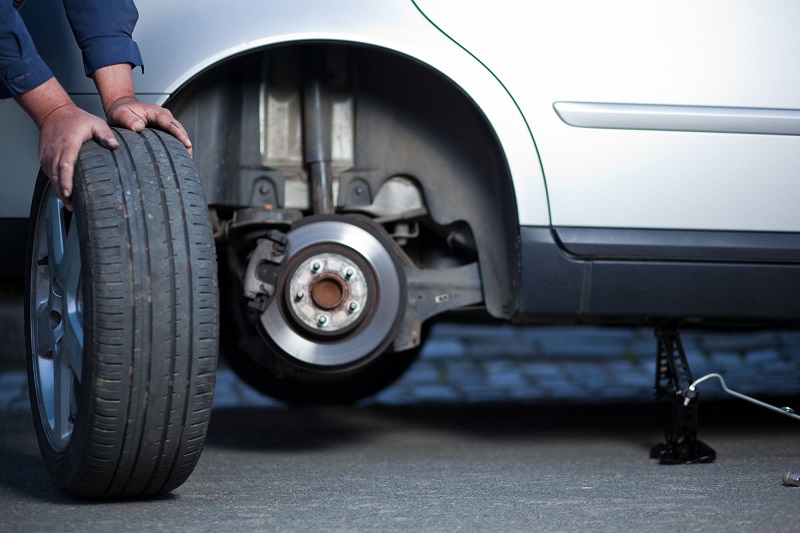
It is a scenario every driver dreads. You hit a jagged pothole or pick up a construction screw right in the tire shoulder, far outside the repairable tread zone. You limp into the local tire shop expecting to buy a single replacement and be on your way for a hundred and fifty bucks. Instead, the technician inspects your vehicle, notices the badges on the tailgate, and delivers an unpleasant verdict: because your car is all-wheel drive, you cannot replace just the damaged tire. You need to buy all four.
To anyone unfamiliar with automotive engineering, that recommendation sounds like an aggressive, opportunistic upsell. In a standard front-wheel-drive sedan, putting a brand-new tire on the non-drive axle rarely causes mechanical headaches. On an all-wheel-drive (AWD) vehicle, however, the technician’s warning is grounded in basic physics and expensive mechanical realities.
Before you drop hundreds or even thousands of dollars on a complete set, you need to understand how AWD systems interpret tire diameter, what actually happens to your drivetrain when tires do not match, and the legitimate workarounds that can save your bank account.
The Mechanical Sensitivity of All-Wheel-Drive Systems
The core challenge comes down to the way AWD platforms distribute power. Unlike two-wheel-drive vehicles that let non-driven wheels spin freely at their own pace, an AWD vehicle actively links all four corners through a sophisticated network of differentials, viscous couplings, transfer cases, and computer-controlled clutch packs.
These mechanical components are designed to allow slight speed variations between wheels when you make a turn, as the outside wheels must travel along a wider arc than the inside wheels. However, when you are driving straight down an interstate, the system expects all four wheels to rotate at virtually the same rate.
When one tire has significantly more tread than the others, its overall diameter is larger, which means its rolling circumference is larger as well. A tire with 10/32 of an inch of tread will complete fewer revolutions per mile than a worn tire sitting at 5/32 of an inch.
While a fraction of an inch sounds negligible, that difference compounds rapidly over distance. Over the course of a highway drive, the smaller, worn tires will spin thousands of additional times compared to the brand-new tire. The vehicle’s AWD system cannot tell the difference between a tire with less tread and a tire that is slipping on ice or gravel. It registers that continuous rotational disparity as wheel slip, prompting the center differential or electronic clutches to engage constantly in an attempt to equalize wheel speeds.
The Expensive Consequences of Drivetrain Strain
Running mismatched tire sizes on an AWD vehicle rarely causes immediate catastrophic failure on your drive home from the shop. Instead, it creates continuous internal friction that degrades components over several months.
Center Differential and Transfer Case Burnout
In traditional mechanical AWD systems, such as Subaru’s symmetrical setups or older Audi Quattro platforms, a center differential or viscous coupling absorbs speed differences. When forced to compensate for mismatched rolling diameters continuously at high speeds, the internal fluid overheats, viscosity breaks down, and internal clutch plates glaze or warp. Replacing a fried center differential or transfer case routinely costs between three and five thousand dollars, dwarfing the price of three extra tires.
Electronic Clutch and Sensor Confusion
Modern crossovers often utilize on-demand, electronically managed AWD systems. These platforms use multi-plate clutch packs and wheel-speed sensors to route power rearward only when slip is detected.
A single larger tire sends conflicting telemetry to the electronic control module. The computer may trigger intermittent anti-lock braking interventions, throw traction control warning lights, or force the vehicle into a defensive limp-home mode. Even worse, the constant micro-engagement of electronic clutches accelerates wear on solenoid packs and electronic actuators.
Understanding Tread Depth Tolerances
Automakers understand that tires do not always wear down at identical rates, which is why every manufacturer publishes a maximum allowable variance across all four wheels.
As a general benchmark across the automotive industry, the acceptable threshold for tread depth difference on an AWD vehicle is between 2/32 and 3/32 of an inch. Some manufacturers express this tolerance as a rolling circumference variance, typically requiring all four tires to remain within one-quarter to one-half inch of each other.
If your remaining three tires are relatively fresh—say they measure at 8/32 or 9/32 of an inch while the new tire starts at 10/32—you are safely within manufacturer tolerances. In that specific circumstance, buying a single replacement tire is acceptable.
If your remaining tires are down to 5/32 or 6/32 of an inch, mounting a brand-new tire at full factory depth pushes you well past safe engineering limits. At that point, running that single new tire creates an unacceptable risk of drivetrain damage.
Smarter Alternatives to Buying Four New Tires
Being forced to replace three perfectly serviceable tires with half their life left is a bitter pill to swallow. Fortunately, you have alternatives that do not compromise your drivetrain.
Tire Shaving
The most cost-effective secret in the tire industry is tire shaving. Several prominent online tire retailers and specialized automotive alignment shops possess dedicated lathe machines that can shave down the tread of a brand-new tire to an exact specification before shipping or mounting it.
If your three good tires are sitting at 6/32 of an inch, you can order an exact replacement model and have the retailer shave the new 10/32 tire down to 6/32 for a nominal fee, usually between thirty and fifty dollars. While it feels counterintuitive to deliberately pay someone to shave off brand-new rubber, sacrificing forty dollars of rubber on one tire saves you from purchasing three additional tires you do not yet need.
Sourcing a Matching Used Tire
Another viable route is sourcing a matching used tire. The key here is precision: the replacement must match the existing tires in brand, model, speed rating, and load index, while sitting within 1/32 to 2/32 of an inch of your current tread depth.
You must also verify the tire’s Department of Transportation (DOT) date code stamped on the sidewall. Never mount a used tire that is more than five or six years old, regardless of how much tread remains, as rubber compounds oxidize and harden over time, leading to compromised wet traction and unpredictable handling.
Replacing an Axle Pair on FWD-Biased Platforms
On certain part-time, front-wheel-drive-based AWD systems, the manufacturer may allow you to replace tires in pairs across a single axle rather than all four, provided the difference between the front and rear axles stays within strict factory bounds.
Always consult your specific vehicle’s owner manual before attempting this. If you replace an axle pair, tire specialists generally recommend installing the two newest tires on the rear axle to maintain vehicle stability and prevent snap oversteer during emergency wet-weather maneuvers.
Making the Practical Call
Deciding your next step comes down to honest arithmetic. If your current set is sitting near the legal wear limit of 3/32 or 4/32 of an inch, trying to save them is a false economy. Your tires are already due for replacement, and buying a complete set of four restores optimal wet-weather braking, snow traction, and peace of mind.
If your remaining three tires still have years of usable life, step away from the panic purchase. Take the vehicle home on a compact spare or arrange a brief rideshare, measure the tread depth with an inexpensive gauge, and look into ordering a shaved tire or finding an exact used match. Understanding the mechanical stakes allows you to protect your drivetrain from ruin without letting a single flat tire drain your savings.